The sbabae blog
SBA 7(a) vs. conventional loans for buying a business
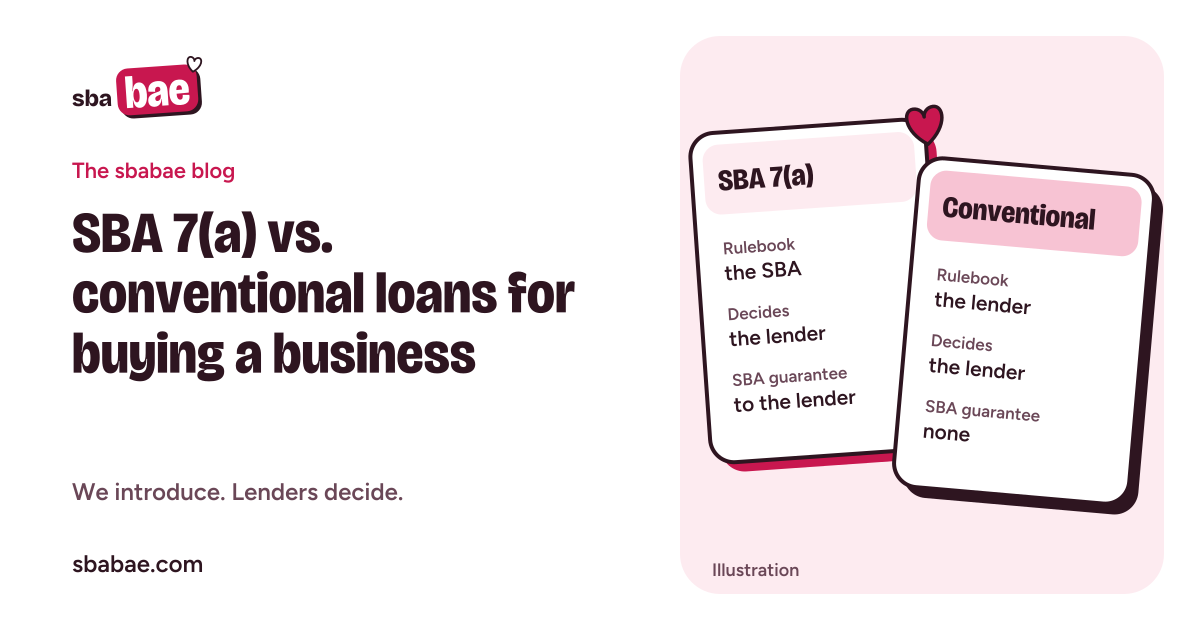
If you are buying a business, the first fork in the financing road is usually this one: an SBA-backed 7(a) loan, or the lender's own conventional loan. Both are made by a lender. The difference is whose rulebook governs and who shares the lender's risk.
The one-sentence difference
A 7(a) loan is made by a lender under the SBA's program rules, and the SBA guarantees part of it to the lender. A conventional loan is the lender's own product, under the lender's own policy, with no SBA guarantee. In both cases the lender decides whether to lend and on what terms.
What the SBA guarantee is, and is not
The SBA guarantees up to 85% of 7(a) loans of $150,000 or less and up to 75% of larger loans (SOP 50 10 8.1, Appendix 16 (opens in a new tab)). That guarantee protects the lender if the loan goes bad. It does not protect you: you still owe the full loan, and anyone owning 20% or more of the business must guarantee it personally (SOP 50 10 8.1 (opens in a new tab)).
Why it matters to you anyway: a guarantee can make a lender more willing to finance a deal it would not take on alone. That is also why 7(a) has an eligibility test. The SBA describes the program as being for operating, for-profit US businesses that meet its size standards and cannot get credit on reasonable terms elsewhere (SBA 7(a) loans page (opens in a new tab)).
What the 7(a) rulebook fixes for an acquisition
For a change of ownership, the SOP sets a baseline every 7(a) lender works within:
- An equity injection of at least 10% of total project cost for an initial acquisition, which cannot be reduced or waived (Appendix 15 (opens in a new tab)).
- Debt service coverage of at least 1.25 on initial acquisitions: at least $1.25 of yearly cash flow for every $1.00 of yearly loan payments (Appendix 15 (opens in a new tab)).
- The seller's financials verified against IRS tax transcripts, and a business valuation from a qualified source (Appendix 15 (opens in a new tab)).
- A quality of earnings report when the price of the business is $3,000,000 or more (Appendix 15 (opens in a new tab)).
- A maximum of $5,000,000 for a standard 7(a) loan (SBA 7(a) loans page (opens in a new tab)).
We walk through each of these in what lenders look at when you buy a business. Remember that these are floors. A lender can ask for more.
What a conventional lender sets on its own
With a conventional acquisition loan there is no SBA rulebook in the middle. The lender's own credit policy decides how much equity it wants, how it measures cash flow, what collateral and guarantees it needs, how long the loan runs and what documents it asks for. Those answers vary from lender to lender and from deal to deal, so we do not publish typical numbers for them. Anyone who quotes you conventional terms before seeing your deal is guessing.
Because the policy is the lender's own, a conventional loan is not limited by the SBA's eligibility test or its $5,000,000 standard cap. It is limited by what that lender is comfortable with.
Paperwork and process
An SBA loan carries SBA forms on top of the lender's own requests: typically Form 1919 (borrower information), Form 413 (a personal financial statement) and IRS Form 4506-C, which lets the lender request tax transcripts (SOP 50 10 8.1 (opens in a new tab)). A conventional loan uses the lender's own package. Either way, the core of the file is the same: the seller's records, your LOI, your equity and your plan for the business.
Fees, agents and who pays them
On an SBA loan, the rulebook is specific. A referral agent can be paid by the borrower or by the lender, never both, and any fee is disclosed on SBA Form 159. Fees you pay an agent do not count toward your equity injection, and the SBA does not require you to use an agent at all (SOP 50 10 8.1 (opens in a new tab)). On a conventional loan, ask the lender to list every fee in writing before you commit.
Questions to ask any lender
- Do you finance acquisitions like mine with 7(a), with your own conventional loans, or both?
- What equity do you want, and which costs do you count in the total?
- How do you measure the business's cash flow, and which seller adjustments do you accept?
- What collateral and personal guarantees will you ask for?
- Which fees are charged, who pays each one, and when?
- What documents do you want first, and what is your process from LOI to closing?
So which one fits?
There is no universal answer, and anyone who promises one is overselling. The right choice depends on your deal, your equity, the business's records and the lender in front of you. Many lenders offer both kinds of loan and can tell you which they would consider once they see the file.
Where sbabae fits
We are not a lender and not the SBA. We introduce you to one lender at a time that does this kind of financing, and we tell you its name before we send anything. Lenders decide everything that matters: whether, how much and on what terms. If you would rather search on your own, the SBA's free Lender Match (opens in a new tab) tool is a good place to start.
General education, not advice and not a decision about your request. Lenders make every credit decision and set their own terms. We do not promise approval, rates, terms or timelines.
Sources
- SBA SOP 50 10 8.1 (opens in a new tab), effective October 1, 2026; Appendix 15 (acquisitions) and Appendix 16 (guarantee).
- SBA 7(a) loans page (opens in a new tab), updated March 26, 2026.
- SBA Lender Match (opens in a new tab).