The sbabae blog
What lenders look at when you buy a business
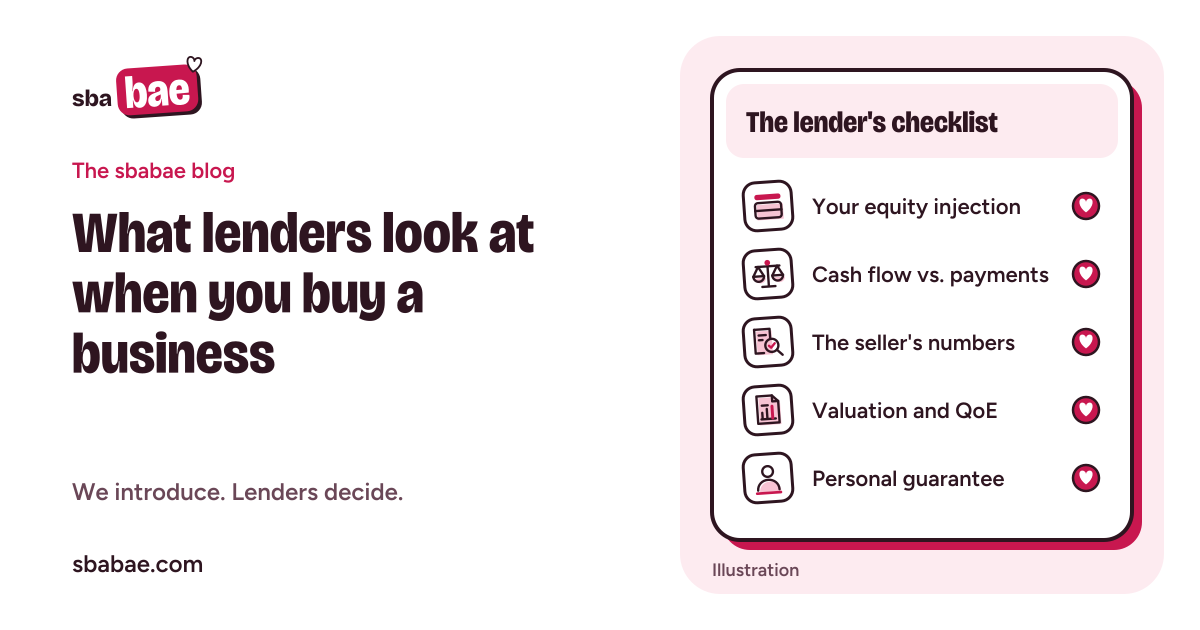
When you borrow to buy a business, the lender is really looking at two things at once: you, and the business you want to buy. Knowing what goes on that checklist before you sign a letter of intent (LOI) makes the whole conversation shorter and calmer.
Most of what follows comes from the SBA's public rulebook for its 7(a) loan program, the Standard Operating Procedure 50 10 8.1 (opens in a new tab), effective October 1, 2026. 7(a) is one option many lenders offer for acquisitions, and the rulebook sets a floor. Each lender then adds its own requirements, so treat this as the questions you will be asked, not a list of answers you will get.
1. Your equity injection
For an initial acquisition financed with a 7(a) loan, the buyer brings an equity injection of at least 10% of the total project cost, and the rulebook says it cannot be reduced or waived (SOP 50 10 8.1, Appendix 15 (opens in a new tab)). That cash is your stake in the deal, and lenders will want to see where it comes from.
Two practical points. First, ask each lender exactly which costs it counts in "total project cost" for your deal, because that number drives the 10%. Second, fees you pay to an agent or broker do not count toward your equity under the same SOP, so budget for them separately.
2. Cash flow compared with the loan payments
Lenders want to see that the business can carry its new debt. On initial acquisitions with a 7(a) loan, the rulebook looks for debt service coverage of at least 1.25 (SOP 50 10 8.1, Appendix 15 (opens in a new tab)). In plain terms: for every $1.00 of yearly loan payments, at least $1.25 of yearly cash flow.
How a lender measures that cash flow is its own call. Adjustments that look obvious in a seller's summary (often called add-backs) may or may not be accepted, which is why two lenders can read the same numbers differently. Ask early how a lender calculates cash flow for an acquisition, and whether it uses the seller's history, your projections or both.
3. The seller's numbers, checked against tax records
A seller's profit and loss statements are a starting point, not the final word. For acquisitions, the rulebook has lenders verify the seller's financial information against IRS tax transcripts (SOP 50 10 8.1, Appendix 15 (opens in a new tab)). The IRS Form 4506-C is the request that lets a lender obtain those transcripts.
If the books and the tax returns tell different stories, expect questions. It is far better to find that gap yourself during your own review than to have it surface late in underwriting.
4. A valuation, and sometimes a quality of earnings report
The lender wants a supportable value for what you are buying. Under the SOP, the lender gets a business valuation from a qualified source, and when the price of the business is $3,000,000 or more, the lender asks for a quality of earnings (QoE) report (SOP 50 10 8.1, Appendix 15 (opens in a new tab)). A QoE is a deeper accounting review of whether the earnings are real and repeatable.
A price well above what the valuation supports is a common reason deals need rework. Agreeing a price you can defend with records makes the rest of the process easier for everyone.
5. You, as the borrower
Lenders look at the buyer as closely as the business. Anyone who will own 20% or more of the business must guarantee the loan personally (SOP 50 10 8.1 (opens in a new tab)). Expect SBA Form 1919 (borrower information) and Form 413 (a personal financial statement), plus the IRS Form 4506-C.
Practitioner checklists add the documents that tell your story: your resume, the signed LOI, and several years of the business's tax returns along with year-to-date financials (Clearly Acquired, first-time buyer checklist (opens in a new tab)). Industry experience and a clear plan for the first year matter, because the lender is betting on you running the business.
6. Whether the deal fits the program at all
The SBA describes 7(a) borrowers as operating, for-profit businesses in the US that meet the SBA's size standards and cannot get credit on reasonable terms elsewhere. A standard 7(a) loan goes up to $5,000,000, and the program can fund changes of ownership as well as working capital, equipment and refinancing business debt (SBA 7(a) loans page (opens in a new tab)). If your deal sits outside those lines, a lender may suggest its own conventional loan instead; our companion post on SBA 7(a) versus conventional acquisition loans walks through that choice.
What the rulebook does not decide
The SOP sets minimums. It does not decide your loan. Each lender sets its own credit standards, pricing, collateral requirements and timing within the program rules, and two lenders can look at the same file and reach different answers. That is normal, and it is why the right lender matters as much as the right deal.
A short preparation list
- A signed or near-final LOI that names the price and what is included.
- The seller's tax returns and year-to-date financials, and your own reconciliation of the two.
- A clear source for your equity injection, with statements to show it.
- Your resume and a one-page plan for the first year of ownership.
- A list of questions for each lender: what counts in total project cost, how cash flow is measured, what collateral and guarantees it needs, and what documents it wants first.
Where sbabae fits
sbabae is not a lender and not the SBA. We introduce businesses and buyers to independent lenders that do this kind of financing, one lender at a time, and we tell you the lender's name before we send anything. We do not judge eligibility; lenders make every credit decision. You do not need a referral service: the SBA's free Lender Match (opens in a new tab) tool can also connect you with participating lenders.
General education, not advice and not a decision about your request. Lenders make every credit decision and set their own terms. We do not promise approval, rates, terms or timelines.
Sources
- SBA SOP 50 10 8.1 (opens in a new tab), effective October 1, 2026; Appendix 15 covers acquisitions.
- SBA 7(a) loans page (opens in a new tab), updated March 26, 2026.
- Clearly Acquired, first-time buyer checklist (opens in a new tab), practitioner document list.
- SBA Lender Match (opens in a new tab).